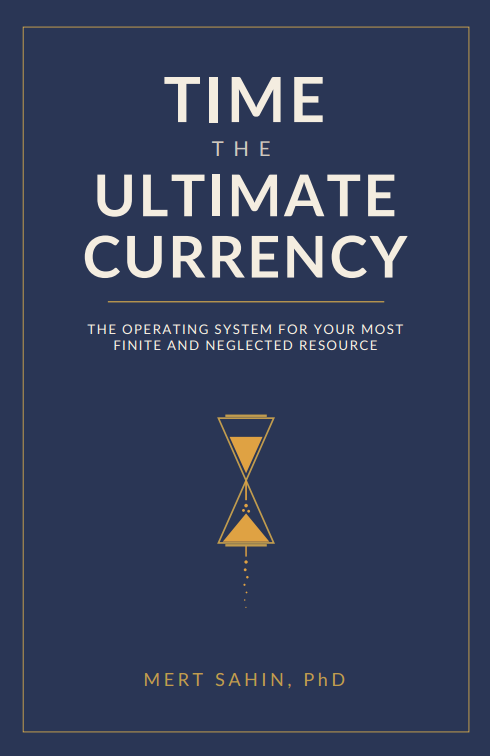
A framework, not a pep talk.
You learned budgets, compound interest, the difference between an asset and a liability. No one built the equivalent for time. So the hours you spend on things that matter pass by in fragments, a few minutes here, half an hour there, and the days feel full yet empty with little accomplished at the same time. The book calls this time poverty.
The answer is not moving faster or doing more. It is measurement. Time is the one currency you spend without a price tag, and this book gives it the operating system money already has: a rate, a ledger, and the rules to use them.
By Mert Sahin, PhD. Templates for filling out the exercises mentioned in the chapters are included after each chapter.
Once an hour has a price, the calendar argument stops being about preference and starts being about arithmetic.
Five parts, built in order
Each part rests on the number at the base. Nothing higher up can be worked out until the part beneath it has been.
TIME EXCHANGE RATE = net value kept ÷ the hours the activity truly consumes
The rate is the foundation course. The four parts above it are what the rate makes possible.
Redefining wealth
Calculate your Time Exchange Rate. What one hour of your life is actually worth after tax, commute, work-related costs and the unpaid hours the job really takes.
The time ledger
Every hour is an expense, an investment or waste. The ledger is what turns a calendar into a set of accounts you can read.
Time as business currency
The same rate applied to the decisions a business makes: what an executive's portfolio of hours is buying, what a deal returns once its time cost is counted, and where the floor sits.
Time as personal currency
What the rate changes outside work: which tasks are worth buying back, when the rate needs recalibrating, and what purchases and relationships look like once they are priced in hours.
Living at a time surplus
The apex of the arc. Designing a system that holds, and reading the ledger across a twenty-year horizon rather than a week.
Fifteen chapters, fifteen exercises
Every exercise below follows a blank template printed in the book. All fifteen are also available as interactive worksheets, which calculate as you type and save to your own browser rather than to a server.
Part One: Redefining wealth
- Chapter 2Calculate your Time Exchange RateAbout 10 minutes
- Chapter 3Time confetti auditAbout 5 minutes
Part Two: The time ledger
- Chapter 4Personal time budgetAbout 20 minutes
- Chapter 5Identify time wasteAbout 10 minutes
- Chapter 5Weekly ledger tagAbout 20 minutes
- Chapter 6Barrier identificationAbout 10 minutes
Part Three: Time as business currency
- Chapter 7Executive portfolio auditAbout 20 minutes
- Chapter 8Set your floorAbout 10 minutes
- Chapter 9Role time functionAbout 15 minutes
- Chapter 10Deal time-adjusted returnAbout 15 minutes
Part Four: Time as personal currency
- Chapter 11Time-buying task listAbout 15 minutes
- Chapter 12Recalibrate your TERAbout 5 minutes
- Chapter 13Purchases and relationships inventoryAbout 20 minutes
Part Five: Living at a time surplus
- Chapter 14Design a systemAbout 15 minutes
- Chapter 15Twenty-year ledger horizonAbout 15 minutes
Who this is for
Anyone comfortable with the concept of money yet short on time. Written for executives making calendar decisions worth more than they look, founders whose own hours are the company's real constraint, and anyone financially literate who wants a framework instead of another productivity hack.
If you want motivation, this isn't it. If you want a system, it is.
Start before the book does
The method does not wait on the publication date. You can work out your own rate in about two minutes, read the full definition of the measure, or bring it to a room.
- Calculate your Time Exchange Rate, the number Part One is built on.
- Read the full definition of the Time Exchange Rate, including what goes into the numerator and the denominator.
- Book a keynote or workshop on the Time Exchange Rate, in one of four formats.
- About the author.